
The Satyam Scam Explained
Published:
Noticed those once-in-a-while AIC posters around campus? Something about…The Satyam saga…The Tech phoenix…? Let’s break this down.
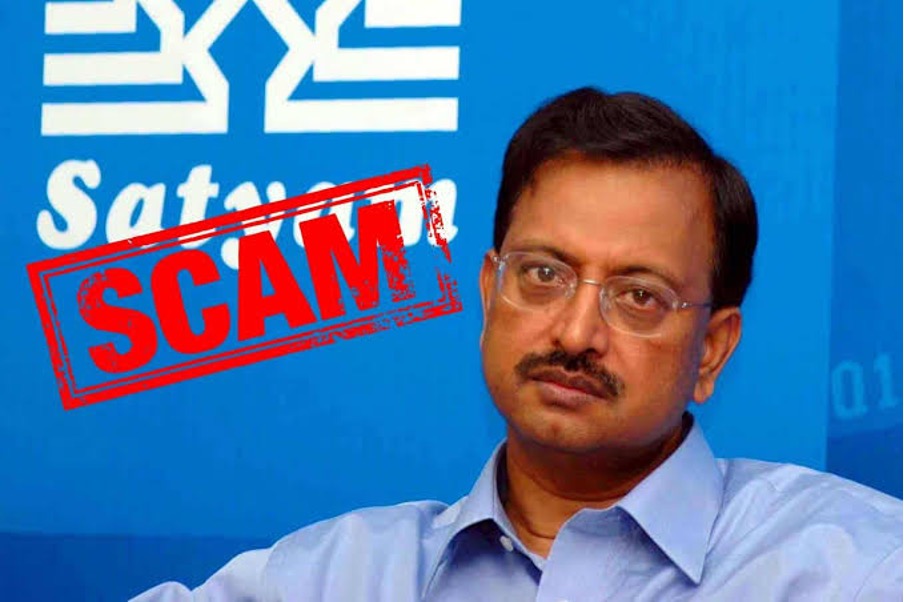
Satyam Computers, formed in 1987 in Hyderabad by Mr. Ramalinga Raju, was once the crown jewel of the Indian IT services industry. The firm began with 20 employees(whom they called ‘associates’), rapidly becoming the country’s 4th largest company after TCS, Infosys and Wipro; operating in as many as 65 countries in the world. It was one of the first Indian IT companies to be listed on international exchanges like NYSE and EURONEXT.
But on 7 January 2009—
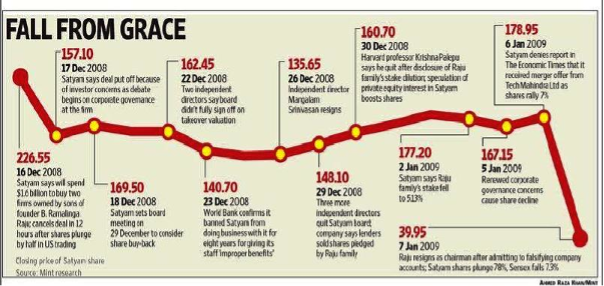
India and the global IT industry watched in horror as a letter written by B. Ramalinga Raju, confessing to orchestrating one of the biggest financial frauds in history, flashed on all news channels. Out of ₹5361 crores of cash and bank balances shown in the books, ₹5040 crores were non-existent. 18.5% of the debtors(~490 crores) were fictitious, 376 crores of accrued interest were false, and there was an understated liability of 1230 crores. Add the asset side(5040+490+376), and you get 5906 crore of bogus assets, matched by the exact amount of bogus reserves on the liabilities side. These bogus reserves were made by inflated billing; the Sep’08 quarter recorded a profit of 649 crores when it was in reality 61 crores. (the 24% shown, was in fact <3%). Inflated billing, non-existent cash and bank balances, overstated debtors, understated liability—Satyam had quite literally tried everything.
But how did this start?
It’s believed to have started in the aftermath of 2000. The software industry had cracked the Y2K code, and Satyam was part of it. Subsequently, both revenue and profit dipped, and despite his best efforts to push delivery and billing, there was a gap between plan and performance. It was bound to impact the company’s rating in the market and lead to a sharp fall in stock price. Possibly this was then the idea occurred to Raju to bridge the gap with fictitious numbers. It’s also believed that he needed this to purchase acres of land in Andhra Pradesh amidst a booming realty market.
So to do this, Raju needed artificial billing to show Satyam was in the premier league. These fictitious invoices led to bogus debtors. But these debtors cannot stay outstanding for so long(in an audit, outstanding beyond 6 months is scrutinized), so he needed to show that he’s getting money—which required him to fabricate bank statements to show a flow of money. Now this money had to be invested somewhere, which led to the creation of bogus fixed deposits. These deposits also showed fake interest income that reflected in the asset side.
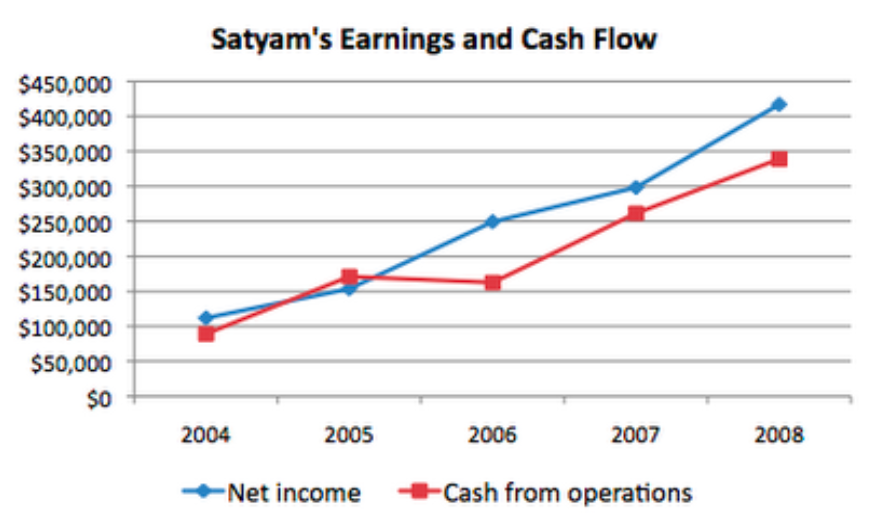
Usually as an early warning sign of financial reporting fraud, investors look at the differences between cash flow and income closely. Since overstated revenues can’t be collected and understated expenses have to be paid, companies that misreport incomes often show a much stronger trend in earnings than in cash flow from operations. But Raju managed to manipulate cash flow too, as with the bogus fixed deposits. The Satyam scam was thus a stunningly and cleverly articulated comprehensive fraud, which went unnoticed by the SEBI, retail investors, external auditors, etc.
If everything was going so well, what triggered the confession?
Global financial crisis—2008. Satyam had cash flow issues and needed to raise money, but why should it need money when it had so much money in the bank? It was fake, but the bank didn’t know that, and so would raise suspicion if Satyam asked for money. Some vertical heads had also pointed out the turnover that was reflected in the audited statements was greater than what they had actually achieved. The Rajus had pledged their shares for borrowings as well, when their holdings were only 8%. As the share prices began descending in the wake of the global financial crisis, the lenders applied pressure for additional securities. The threat of an equity takeover was also stark, since that would expose the gap. If outside agencies called out the fraud, the consequences could be devastating. America’s SEC would step in, he would be deported to the US for trial and taken away for long. Or maybe he wrote the confession so Satyam could survive. In the words of T.N. Manoharan, “I believe this version of ‘an inherently decent man who slipped on the righteous path’ when I read Raju’s giveaway line in his confession, ‘It was like riding a tiger, not knowing how to get off without being eaten.’”
Aftermath
The Indian government appointed a new board of directors to save the company, and to save the country’s reputation; after all, Satyam operated on a global scale, and such an event had tarnished the name of the country. The board proposed a revival plan, and the goal was to acquire a strategic investor post 100 days. On 13 April 2009, via a formal public auction process, a 31% stake in Satyam was purchased by Tech Mahindra, as part of its diversification strategy. Effective July 2009, Satyam rebranded its services under the new Mahindra management as “Mahindra Satyam”.
This is one of my articles on the Bodhi newsletter, find their substack here.