
Trump Tariffs: Panic and Paralysis
Published:
“THIS IS A GREAT TIME TO BUY!!!”, Trump’s post just a few hours before he announced a 90-day pause on most of his new tariffs (except China). This news sent the S&P 500 up 9.5% for the day. Great news for someone who took the President’s advice and made a decent profit.(Is this even legal!?) On April 2, 2025, Trump declared a 10% tariff on all imports, effective on April 5, with additional country-specific tariffs set to commence on April 9.
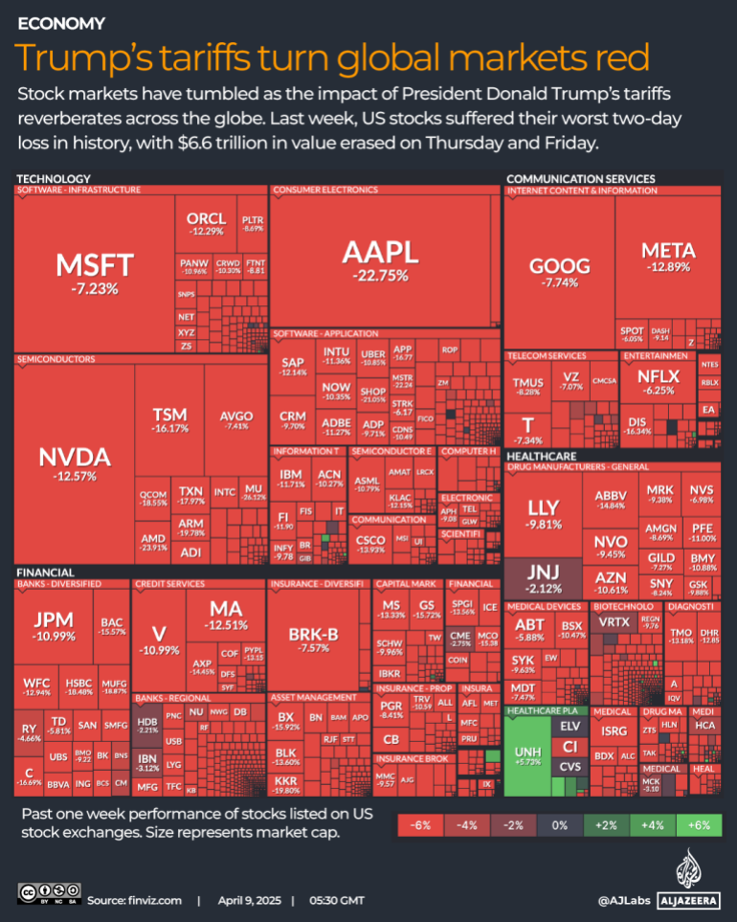
This announcement sent shockwaves to the global economy, while Trump justified the imposition of reciprocal tariffs, ‘Our country and its taxpayers have been ripped off for more than 50 years. But it’s not going to happen anymore.’
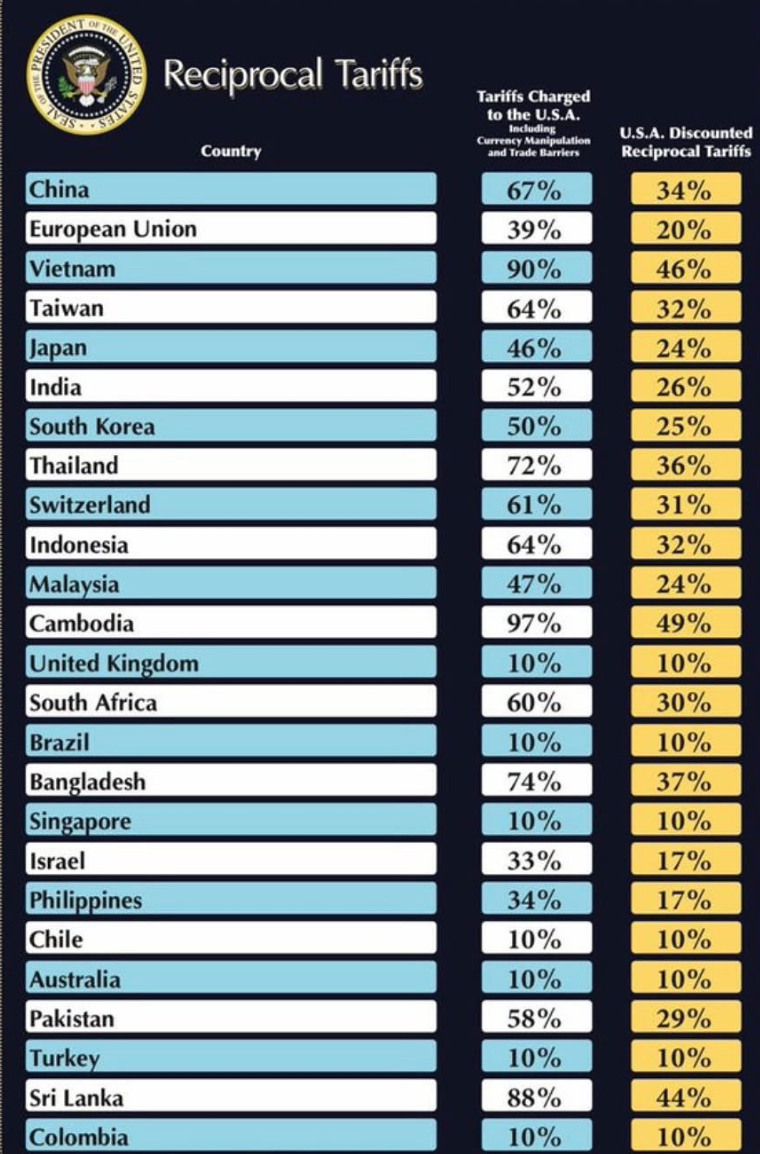
Let’s step back a little, and understand in brief what tariffs mean for global trade.
What are tariffs and what is its impact?
A tariff is a tax imposed by a country on products imposed imported from other countries. Tariffs are usually paid by companies that import goods from abroad. For example, if Walmart imports a $100 shoes from Vietnam, which faces a 46% tariff, Walmart owes $46 to the US Government. Now Walmart can do 3 things, absorb the cost itself(and hurt their profit margins), force it on Vietnamese shoe manufacturers or pass it on to the consumers; or do some combination of these 3.
The president’s stance on imposing reciprocal tariffs is that American trade deficits (US imports – US exports) with other countries is bad, and that America has long been ‘ripped off’ or ‘subsidising’ other countries. According to him, he wants to force tariffs so high such that it forces companies to shift production to the US. This in turn, he says, will increase employment and push up wages. The revenue from tariffs can be used for tax cuts, he said.
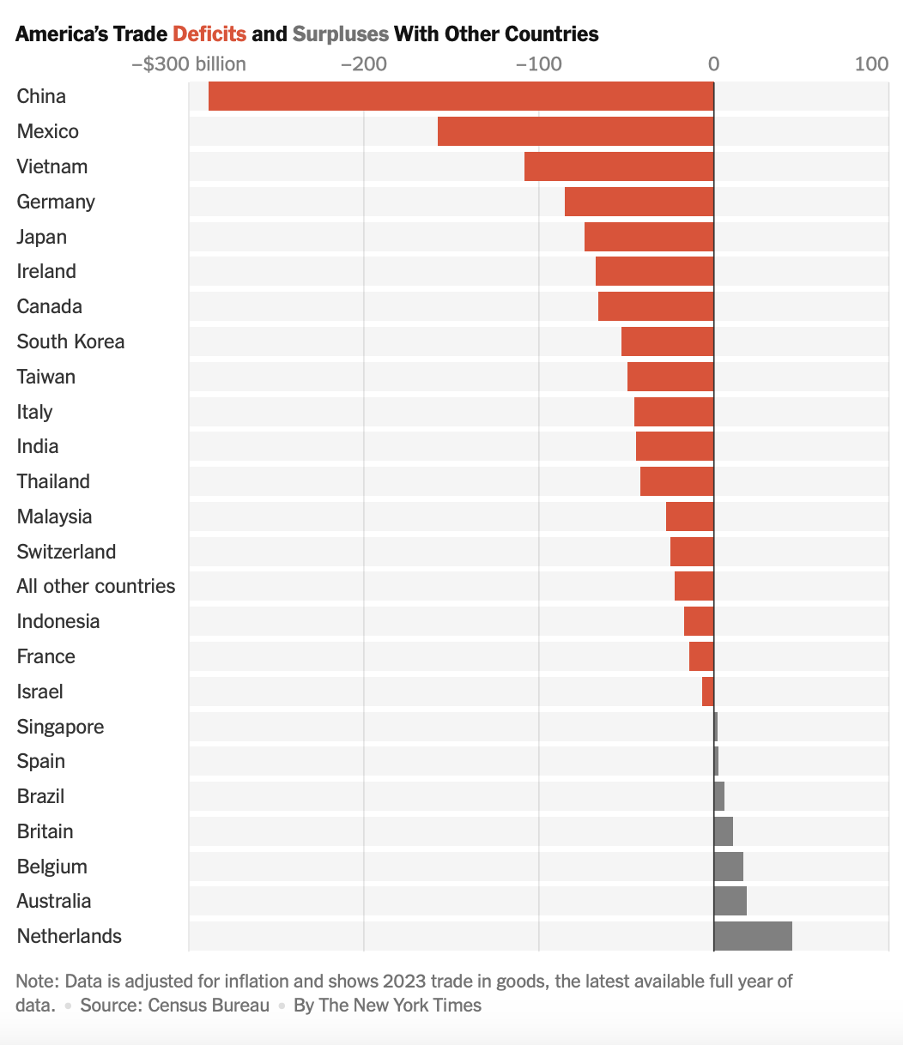
Economists have been contesting his arguments, saying tariffs cannot simultaneously achieve all of the stated goals. The same tariffs that are supposed to boost US manufacturing, are hurting US manufacturers by disrupting supply chains and raising the cost of their raw materials. There is no reason why extra tariffs could eliminate the trade deficit, as that arises when Americans choose to save less than their country invests. Consumers will pay more and have less choice. It’s long been known in economics that tariffs act as barriers to trade, that decrease foreign competition and makes domestic companies less productive. As stock markets fumbled, shares in Nike, which has factories in Vietnam fell by 7%. Does America prosper only when the American sews their own running shoes? Mr. Trump might believe that. Studies show that the calculation of tariffs charged to the US was done in a very rudimentary manner. The document sent by the White House displays a little complex formula for calculating tariff rates:
\[\Delta \tau_i = \frac{x_i - m_i}{\varepsilon \cdot \varphi \cdot m_i}\]where \(x_i\) = total exports to the country, \(m_i\) = total imports from the country, $\varepsilon$ = price elasticity of import demand (set at 4) and \(\varphi\) = elasticity of import prices with respect to tariffs (set at 0.25). Except that \(\varepsilon \times \varphi = 1\), and doesn’t add anything to the calculation. The formula just becomes trade deficit as a % of total imports for a particular country. Such a reductionist approach to calculate tariffs charged to the US is not just embarrassing for the administration, it also portrays a negative image for other countries when they show tariff rates that are in reality, not true. These rates were then just simply halved and set as reciprocal tariffs.
Earlier in the 20th century, after the stock market crash of 1929, the Smoot-Hawley Tariff Act of 1930 was enacted in an attempt to protect US businesses. Instead, the tariffs did not work and the US sank deeper into the Great Depression.
Now that we have a decent understanding of the impact of tariffs, let’s get back to the timeline. After the announcement of reciprocal tariffs, a lot of countries approached the US to negotiate with bilateral trade agreements. Some countries fought back.
How did trading partners respond?
China’s Finance Ministry announced a 34% tariff on imports from the United States, matching Mr. Trump’s plans for 34% tariffs on exports from China. The Chinese Ministry of Commerce also barred a group of 11 American companies from doing business in China. Mr. Trump threatened to counter Beijing’s retaliatory tariffs with an additional 50% tariff on China. Those tariffs would be additive, meaning that China could face 104% taxes on all exports. China responded with an additional 50% tariff on U.S. goods, meaning all American goods shipped to China faced an additional 84% import tax. Amidst the deepening trade war, Singapore’s PM (faced with the baseline 10% tariffs) highlighted the danger of increasing protectionist trade policies throughout the world, with the US abandoning the free market values it stood for a long time until recently.
To demonstrate the degree of volatility in the current market, consider the havoc that ran through the market on Apr 7:
At 10:10 am ET, rumours spread that the White House was considering a 90-day tariff suspension. In the next 8 minutes, the S&P 500 added $3 trillion in market capitalisation. At 10:34 am ET, the White House officially called the tariff pause headlines ‘fake’. By 10:40 am ET, the S&P 500 erased -$2.5 trillion of market cap from its high, 22 minutes prior.
Now, back to the headline:
The economic turmoil, particularly a rapid rise in government bond yields, caused Mr. Trump to blink on Wednesday afternoon and pause his “reciprocal” tariffs for most countries for the next 90 days, according to four people with direct knowledge of the president’s decision. China would not be included in that pause, he said. Instead, he raised tariffs on its exports to 125% after Beijing announced a new round of retaliation, in addition to the 20% tariffs, bringing the total tariffs on China imposed by the Trump administration to 145%. Judging by Mr Trump’s on-again, off-again approach to tariffs on Canada and Mexico, there is reason to think he will revive his threat of higher tariffs before the 90 days are up. ‘Make America Great Again’, what greatness means in the US for Mr. President remains to be seen.
What about India?
Given such a painful trade war with China, export flows could shift to emerging economies like India and Brazil. Companies like Apple are hoping to shift production to India as soon as possible which might give a boost to India’s GDP. Jaishankar emphasized that India’s strategy has been focused on constructive engagement with the Trump administration, with the goal of reaching a bilateral trade agreement. “To the best of my knowledge, and I could be corrected here, I think we are the only country after President Trump has resumed the presidency the second time, which has actually reached such an understanding in principle,” Jaishankar added.
This is one of my articles on the Bodhi newsletter, find their substack here.